The Goalie Guru blog, and all its linked materials, is offered as a one-stop resource to assist ice hockey goaltenders, their coaches and parents (realizing that the latter two are often one and the same) in gaining a better understanding of this truly unique position. Comments, questions, and suggestions welcomed! Reach me at 978-609-7224, or brionoc@verizon.net.
Showing posts with label coaching. Show all posts

Tuesday, February 19, 2019

Sports without sportsmanship is a hollow activity

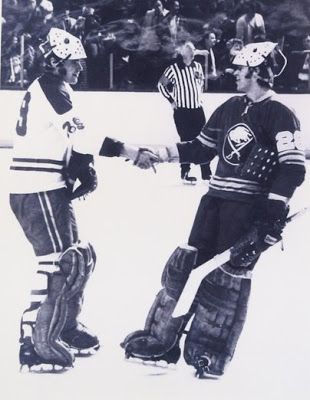
You don't have to be brothers - like Ken Dryden, left,
and Dave Dryden - to embrace good sportsmanship.
Hi gang,

I've been thinking about the concept of "sportsmanship" quite a bit lately, promptly by the unseemly practice of schools lobbying for their candidates for college hockey's Hobey Baker Award (really, if you're campaigning for this award, you have no idea why Baker was selected to represent college hockey's highest honor, and you should do some homework).

Sportsmanship, for me, is a critical component to playing sports. Winning is important, don't get me wrong. So is playing the right way. It's about treating your opponents, your teammates, the refs, and the game with dignity and respect. That's what this column is about.

Let me know what you think. Best, -Brion

##

SPORTS WITHOUT SPORTSMANSHIP IS A HOLLOW ACTIVITY

February represents the stretch run for most high school hockey seasons. In other words, this is the time of the season when coaches tend to get hyper-focused on winning, whether it's simply to make the playoffs, or to get a better post-season seed. Far too often, I've seen coaches lose their composure, and their sense of sportsmanship. And if a coach loses sight of the overriding values that these game are supposed to impart, what can we expect of the players?

Last spring, I watched with serious concern and consternation as a local girls hockey coach went on a Twitter rant when his team lost a playoff game, in a shootout, against a lower-seeded squad. The game-winning goal may (or may not) have been hit a second time by the shooter. Hockey fans, coaches, and refs know that, in a penalty-shot scenario, a player can't touch the puck a second time after it's shot. In this case, the refs ruled that the puck wasn't hit twice, which ended the game.

Afterward, the coach of the losing squad took to Twitter to vent. Here's a sampling:

"They blew the call and I could tell they knew it."

"The player clearly saw the puck laying there after the initial attempt, instincts tell her to tip it again. Bad bad call."

"Why are the officials out of position? Horrible."

Now, I understand in this day and age, Twitter allows people – even our highest-ranking elected official – to go complain publicly whenever they feel like it. But I was clearly disheartened by the obvious lack of class, and the total absence of sportsmanship, on display in the coach's tweets.

To make matters worse, some players on the coach's team apparently followed his lead. At least one team captain refusing to take part in the handshake line after what had been an outstanding girls high school hockey game. That's such a shame. After all, we're talking about a girls hockey game. Yes, the games are important, especially a playoff game. But that's exactly when sportsmanship is supposed to trump bad behavior.

The more important the game, the higher the stakes, the more sportsmanship should matter. That's why Hobart Amory Hare "Hobey" Baker is a genuine hero of mine.

Baker, who played hockey and football at St. Paul's School in New Hampshire and Princeton University, was so supremely talented that he drew special attention from his opponents. Many of those opponents took liberties, and at a time (early 1900s) when hockey was incredibly rough, Baker took a beating. But he didn't retaliate. Instead, Baker was the epitome of "letting his play do the talking." After the game, he would visit the opponents' locker room to shake hands with each player.

Following his graduation from Princeton, where his team won two national championships, Baker joined the St. Nicholas Club in New York. During the 1914-15 season, when he led the club to national amateur championship, arenas advertised games by posting "Hobey Baker Plays Tonight," which embarrassed him. Baker would plead with sportswriters to highlight the club, not him.

In 1991, the great Sports Illustrated writer Ron Fimrite said this of Baker: "Through his Spartan example, he imposed a code of behavior on athletes, particularly college athletes, that was accepted, if not faithfully observed, for the better part of four decades. It is now, alas, as forgotten as the dropkick. In the Hobey code, for example, a star player must be modest in victory, generous in defeat. He credits his triumphs to teamwork, accepts only faint praise for himself. He is clean-cut in dress and manner. He plays by the rules. He never boasts, for boasting is the worst form of muckery. And above all, he is cool and implacable, incapable of conspicuous public demonstration."

Sadly, the Hobey Baker Memorial Award Foundation has lost sight of what made Baker great. They've ignored his legacy by turning the award into a popularity contest. School sports information offices churn out marketing material for their candidates, an act that would make Baker cringe. It is the antithesis of what he stood for, which is that no one player was any more important than any other. Baker was all about his team, which, somewhat ironically, is what made him legendary.

A general lack of sportsmanship not only impacts how we deal with opponents, and officials, but also how we treat our teammates. When there's an overall erosion of the values of the game, the fabric that binds a team can fall apart. Conversely, when players put the team first – a basic tenet of sportsmanship – great things can happen.

Here's an example. I'm not using real names, because I haven't asked for parental permission to tell this story. But it's a great story about a player putting his team's interests before his own. "Jack" has worked with us at Stop It Goaltending for at least eight years. And when I say "worked," I mean he busted his tail, and parlayed that work ethic into a chance to play for a solid New England prep school program.

By his sophomore year, Jack appeared to be on track to be the team's starter. But injuries, and the emergence of one of his goalie teammates, derailed that plan. By his senior year, he was resigned to a spot on the bench. Still, Jack continued to strap on his gear, every day, pushing his teammates in practice, making the team better. It paid off, and his squad made the New England prep school playoffs.

That's when Jack was confronted with a gut-wrenching decision. Sitting together in the locker room before the team's first playoff game, the starting goalie confided he had forgotten his skates. The kid was crestfallen, and presumed Jack would take his spot in the net. Jack, though, didn't blink. He knew that he and the starter wore the same skates, and the same size. He also knew the starter had earned this game.

So Jack gave up his skates, and watched as the starter led his team to a win. But I've never been more proud of Jack, and I'm sure his parents were as well. I'm guessing his teammates, and his coaches, felt the same.

More recently, the NCAA college football championship game served up another prime illustration of selflessness, and sportsmanship. Trailing Georgia at halftime, Alabama coach Nick Saban pulled long-term starter Jalen Hurts, a sophomore. Hurts entered the game having won 26 of 28 games over the past two seasons, but was benched after completing just three of eight first-half passes, replaced by freshman Tua Tagovailoa. And the freshman delivered, passing three second-half touchdowns, including the stunning game-winner in overtime.

But what grabbed my attention throughout the second half of the game, and in the celebration following Tagovailoa's heroics, was the dignity that Hurts displayed.

"As a team player, you have to do what's best for the team," Hurts told ESPN. "It was important for me to be true to myself and be the team leader I have always been. Don't change because of a little adversity."

Novelist James Lane Allen said: "Adversity does not build character, it reveals it." Hurts has character in abundance. That, more than his championship ring, makes him a winner. Just like "Jack." Just like Hobey Baker.

FINIS

Tuesday, May 8, 2018

The King's rule: Fun is vital

Henrik Lundqvist shares a lighthearted moment
with teammate and fellow goalie Antti Raanta.
Hi gang,

The last of my rapid-fire three-post medley. At our recent Foundation for Goalie Research and Education symposium, a new topic came to the forefront. Actually, not a "new" topic, but one that's finally getting the attention it deserves. And that topic, in a word, is fun.

Sports have become such a high-stakes activity that many of us, including coaches and parents, lose sight of the fact that these are still games. And games are supposed to be fun. Because, if they're not fun, what's the point? Which reminded me of this great column written by all-world goaltender Henrik Lundqvist for The Player's Tribune. Which led to a column of my own. Let me know what you think ...

##

Lessons from the King: Fun is vital

I'm a big fan of Henrik Lundqvist. The regal Swede has the noble bearing that I love seeing in goaltenders, as if they're almost invincible ("The King" being one of the best, and most appropriate, nicknames in the NHL). Technically, he's a rock star, and beneath that calm exterior is one of the league's fiercest competitors. There have been several years when he's almost single-handedly carried the New York Rangers on his way to collecting 400-plus wins (not to mention the gold and silver Olympic medals in his trophy case). I personally think he's worth every penny of the $9.5 million that the Blueshirts pay him annually.

So when I saw that Lundqvist wrote a "Letter to My Younger Self" in The Players' Tribune, I had to check it out. I wasn't disappointed. Some of his comments to his 8-year-old self are predictable, like the following segment, where he recounts the very first time he put on goalie gear.

"You'll glide to the top of your crease, bend your knees, then glide backward toward the net. And keep gliding. And keep gliding and gliding.

"Eventually, you'll hit the back of the net and topple over. You've fallen, and you can't get up. Nobody told you how heavy the pads were going to be.

"As you're laying there on the ice, completely helpless, your own brother will skate down on a breakaway and bury the puck in the open net. He'll skate away with a big smile on his face, arms in the air, while you lay there staring at the puck in the back of the net. Remember this feeling. It never gets any easier.

"This is just your first practice. In your first game, you'll let in 12 goals. Nowhere to go but up, right? Well, in your second game, you'll let in 18. Don't get discouraged."

These feelings – adjusting to cumbersome gear, feeling embarrassed, dealing with disappointment – are fairly universal in the goaltending community. As is Lundqvist's next thought.

"Believe it or not, this is the start of something beautiful. You have found something that you truly love. No matter how many goals you let in, the feeling of making just one save makes it all worth it. That's how you know you're on the right path."

This is music to my ears. As a goalie, and as a goalie coach, I know exactly how Lundqvist was feeling way back when. I've often told parents, when they ask whether their son or daughter will stick with goaltending, "Oh, don't worry. They'll tell you."

What that means is that the position quickly weeds out kids who simply aren't cut out for the rigors of goaltending. Some will stick it out because they're the only option, or they really enjoy being part of a team. But the ceiling for these kids is always going to be low. Why? Because developing into a really good goaltender takes an incredible amount of hard work and dedication. If you don't love the position, the odds of you committing to those countless hours in the gym and on the ice are slim.

As Lundqvist goes on to say, there's nothing mysterious about becoming great. Good gear will help, but ultimately it isn't the equipment that's going to make a difference. It requires God-given talent, and a willingness to put in the work required to make the most of that talent. It takes heart.

"There's no magic recipe for becoming your hero Pekka Lindmark (the former Swedish national team netminder)," wrote Lundqvist. "You don't need shiny new pads – you won't get your own pair until you're 18 anyway. You don't need expensive camps. You don't even need to be very good yet. The only thing that matters right now is that you keep having fun.

"You can compete like crazy against your brother. But never stop having fun. Be dedicated to having fun."

And that's where The King got me. "Having fun." Such a simple concept, yet so remarkably profound. Despite all the challenges that goalies face, kids who flourish in the position are typically (not always, but typically) the ones having fun. Because if it's not fun, the pressures and expectations of the position can crush you.

Some of my favorite goalies embody this concept. I think of guys like Martin Brodeur and Marc-Andre Fleury, guys who looked like they were absolutely in their element when they were between the pipes, no matter how high the stakes were. Their smiles, their attitudes, were absolutely contagious. One of my favorite clips that airs over and over on the NHL Network is Canadien/Avalanche great Patrick Roy grinning and winking after yet another highlight save.

When I coach young goalies, I still try to nurture, above anything else, a love for the game. If a puck gets by you, try to figure out what happened, try to adjust, but don't agonize over it. Concentrate on what's coming next, not what's in the rear-view mirror. Remember to have fun. After all, it's a game.

I kept playing goalie past my 50th birthday. If my old-goalie hips and back didn't give out, I'd be playing today. I have several friends in their 60s who are still suiting up, and when they complain about this or that hurting them, I tell them to zip it. Because I'm utterly jealous that they're still heading to the rink once, twice, sometimes three times a week. My wife thinks I'm nuts. But, then again, she was never a goalie. There's no way she can understand.

I miss the fun. I miss the chirping, the camaraderie, the physical challenge, the subtle-but-very-real satisfaction of feeling the puck hitting me. Stepping on the ice, fully geared up, was an act of joy. It might not have always seemed like that to others, when my competitive streak occasionally overshadowed the more pleasurable aspects of the game. But, underneath it all, there was no place else I'd rather have been. Because it was fun.

The concept of "fun" is clearly so important to Lundqvist that he ended his missive to his 8-year-old self with this wonderful nugget:

"In fact, let me leave you with one final piece of advice. Tomorrow, when you put on that surprisingly heavy goalie equipment for the first time, right before you step out onto the ice, take a deep breath, block out all your thoughts and worries, and ask yourself a question: 'Why am I doing this?'

"The answer will come to you very quickly. 'I'm doing this because it's fun. I'm doing this because I love to compete. So let's go out there and have a blast.'

"Keep reminding yourself of this when things don't go as planned, even when your stage is Madison Square Garden.

"Being a goalie is 90 percent mental. If you are stuck in your own thoughts or dwelling on negativity you won't have the mental focus necessary to compete and succeed. Nobody tells you this when you're a kid, but the best way to get in the right mindset is to start by having fun. The rest you'll figure out.

"Your life will take you to many interesting places, and many big stages. But it doesn't matter if you're stepping out onto the frozen lake in Åre to battle with Joel, or stepping out onto the ice at Madison Square Garden in front of 18,000 people. It's all the same game.

"It's just ice. It's just a puck. Stopping it is fun."

Words that befit a King. Perfect.

FINIS

Wednesday, March 8, 2017

Improvement closely tied to trust and communication

Coaching goaltenders requires a sublime mix of
empathy, encouragement, and tough love.
Hi gang,

With high school playoffs in full gear, I thought it was a good time to revisit this column I wrote last year for the New England Hockey Journal.

Somewhat coincidentally, I coached the young goalie mentiond in the opening scene this past summer, and learned that she was leaving her public school program and an abusive coach for a spot on a private school roster. Things must have changed sometime between summer and the beginning of the past season, because she was back at her public school by November. I'm guessing she realized she wasn't going to see as much playing time, knowing the other private-school goalie (who is very good).

I'm also guessing she wasn't thrilled about the decision, given the type of coach she was returning to. But playing time is playing time. It's just a shame that some kids have to make uncomfortable choices like this.

Let me know what you think. Thanks!

##

Improvement closely tied to trust and communication

The story was enough to make my goalie coaching head spin. Another parent and I were sitting at our daughters' hockey game. He was telling me how he had stopped by another high school girls' game earlier that night, out of curiosity. The game was a match between a traditional Massachusetts private powerhouse and a public school that was trying to break into the state's upper echelons. It quickly proved to be a mismatch.

The game didn't start well for the public school, and the red-faced coach started screaming at his goaltender. Screaming, across the ice, loud enough for the entire audience to hear. Things like "Wake up! Get your head in the game!" A grown man, screaming at a 16-year-old girl. Brilliant.

Predictably, the public school lost, 6-1. More than that, the public school coach had embarrassed himself, not only in front of his team but also in front of all the parents in the stands. If you're among the minority that thinks this type of "tough love" approach is good, I'm telling you, plain and simply, you're wrong. Listening to this story, I didn't know whether to be angry, or disappointed. Probably both.

There's no "love" involved in this approach. It's harassment. And it's humiliating. The coach lost his cool, which I'm sure contributed to his team losing the game. More than that, he called out a teenage goalie, in a very public way, which almost ensures a level of distrust that will last well beyond that one game.

Before we go any further, I must stress that I'm not advocating pampering any player, especially goalies. Ask any of the goaltenders I work with, and every single one will tell you that I don't cut them any slack. None. Excuses are for losers. The goalie has one job, and that's to stop the puck. It's an incredibly difficult job, admittedly, but no one is holding a gun to the goalie's head. Stopping the puck is the job that goalies sign up for, and excuses prevent improvement.

Trust, on the other hand, is essential, and that starts with good communication.

Nowhere is that more important than the pressure-packed postseason. In the playoffs, coaches need to build their goalies, up, not tear them down. In goaltending, more than any other position, confidence is king. Without it, a goalie is going to struggle. That's why coaches – not goalie coaches, but head coaches – absolutely need to develop a relationship with their netminders.

My good friend and employer, Brian Daccord of Stop It Goaltending, addressed this dynamic in a recent post of his Monday Morning Goalie Coach blog.

"I recently read an article online about marriage, and something really struck me," said Daccord. "Marriages that last are not because the couple agrees on issues, but they have the ability to communicate about the issues. Naturally, I had to immediately apply this to goaltending and the relationship between the head coach and the goalie."

Daccord has witnessed a consistent disconnect between coaches and the team's goaltenders at every level of the game, from Mites to the National Hockey League. It's a baffling situation.

"You would think that a coach who's good fortune rides on his goaltending staff would make it a point to communicate with them and make sure they have a clear head," wrote Daccord. "Far too many goalies are left hanging and spending way too much mental energy trying to figure out where they stand. There are even still coaches that do not notify their starting goalie a day in advance of a start.

"Goalies don't need coaches to blow smoke, but they do need to know where they stand and what role they have on a team," he said. "It is on the coach to do his part by communicating with his goalies and therefore earning their respect and trust. If a coach is straight up with a goalie, there is a greater probability that he will be able to perform at a higher level, in which case everyone wins."

Daccord ran this blog post with a photograph of John Tortorella. The implication was clear. Like another former Ranger coach, "Iron Mike" Keenan, Tortorella (now with the Columbus Blue Jackets) is well known for not only having a hair trigger when pulling his goaltender, but also has a history of throwing his goalies under the bus when things aren't going well. The most famous example of this ploy, of course, is the Canadien coach Mario Tremblay embarrassing future Hall of Famer Patrick Roy, who then forced a trade to Colorado, where he won two more Stanley Cups. Montreal? The Canadiens haven't been back to the finals since saying "au revoir" to Roy.

Now, to some extent, I understand a coach's frustration. The less you know about a position, the less likely you're going to make educated decisions about which goalie to play, and how to approach the goalies before and during the game. But the onus is on the head coach to get up to speed on the nuances of the position. The goaltenders are not only part of their team, but also a vital part of the team's success. That doesn't mean coddling the goalies. It means understanding the position.

I've never babied my goaltenders. Honest assessment is an essential part of the position. But productive communication between the coaching staff and their goaltenders can make an enormous difference in not only the success of the goalies, but the team in general.

Here's an example. For two seasons, I worked with a high school team as a part-time goalie coach. I'd stop by once, maybe twice a week. The coaching staff treated me like some kind of witch doctor, specializing in the dark arts of goaltending. "Take the goalies, we'll work with the rest of the team," was the typical instruction.

The coaches were almost dismissive, to be honest. "Fix our goalies" appeared to be their mantra, without any understanding in their own role in breaking their netminders in the first place (and if you watched a "normal" practice, there was little doubt that their shooting drills weren't helping to develop the goalies).

Now, compare that to my experience this year, where one of the teams I'm helping has two freshmen netminders. Both girls are only 15, with precious little experience. One was a backup last year, as an 8th grader, and never saw any game time. The second is an absolute beginner trying to make the switch from lacrosse goaltending. Needless to say, it's a precarious situation.

But, to their credit, the team's coaches have actively solicited advice. I've heard comments like "We want to make sure we're not contradicting what you're telling them," or "We want an idea of the skating and shooting drills they should be doing when you're not here."

The difference between the two approaches is startling. The latter is far more enlightened, and ensures that the goalies are getting a consistent message. The coaches and I discuss our goalie situation often. We're not always on the same page. They want both girls to get better quicker. I counsel patience. Young goalies will make mistakes. So do the other young players on the team, all of whom have been playing hockey much longer.

That's why keeping those lines of communication open between coaches and goaltenders are so important. For every team. I wish more coaches would understand just how crucial it is to encourage, and not simply critique.

FINIS


Friday, February 10, 2017

Nurturing mental toughness

Viking kicker Blair Walsh, after his missed kick last year.
Hi gang,

Forgive me as I and the rest of New England continue to recuperate from our Super Bowl celebrations. Whether you're a Patriots fan or not (and no, Mark Wahlberg, you're not), you've got to admit that was one hell of a comeback.

The numbers alone say it was the greatest comeback ever in Super Bowl history. Regardless of the numbers, the game revealed this team's intestinal fortitude. Courage. Toughness. It reminded me of the following column, which I wrote about a year ago.

Minnesota Viking Blair Walsh had a similar opportunity to win a playoff game for his squad. But he missed a 27-yard field goal attempt, and the Seattle Seahawks won the game. The column was inspired not by the missed kicked, but by how Walsh rebounded, and how we can all learned to be mentally tougher. (As a nice side note, Walsh was just signed by, of all teams, the Seahawks). I hope Matty Ryan and the Falcons can bounce back as well.

Let me know what you think. Thanks!

#

Nurturing mental toughness

Mental toughness is something we all like to think we have. But the reality is we often don't know if we've got "it" or not until we're put on the spot, when the outcome of a game falls squarely on our shoulders. Ask Minnesota Viking place kicker Blair Walsh about pressure.

It was Walsh who missed a 27-yard chip-shot field goal attempt that would have knocked the defending NFC champion Seattle Seahawks out of this year's NFL playoffs. It didn't matter that Walsh is a very good kicker, hitting 87 percent of his field goal attempts in 2015, including six of eight from beyond 50 yards (for his career, he is 121 of 142, or slightly more than 85 percent). When the big pressure moment came, Walsh's kick went horribly awry, spinning wide left.

To his credit, Walsh didn't hide, and didn't make any excuses (some analysts thought Walsh was done in because the holder left the football's laces facing Walsh's boot). "I'm the one who didn't do my job," he told the collective media.

Of course, Walsh was excoriated on the Internet by cowards with keyboards. That's life in pro sports these days. As Ryan Hiles, a columnist for the Louisville Cardinal (the independent weekly student newspaper of the University of Louisville) wrote, "There's no denying that Internet shaming is now a part of sports."

"It's worth noting when we as a society become comfortable with a certain level of emotional sadism mixed into our daily lives," wrote Hiles. "Sadly enough, we can all be deemed guilty of this sadism to a certain extent. It's become almost a sport of its own to revel in the pain of someone far off with whom we share no relationship or connection."

That's unfortunate, but not surprising, given the general decline is basic human decency over the past two decades (just take a glimpse at any political debate for a refresher course). While maybe not ubiquitous, this rush to judge certainly seems more prevalent.

There is hope, however. A group of Minnesota first-graders, recognizing how devastating Walsh's missed field goal attempt must have been, wrote consoling notes to the place kicker, who returned the favor by visiting their classroom. Hiles, the college columnist, got it too.

"This isn't a plea to stop hurting the feelings of millionaires," he wrote. "They're grown-ups, and they can handle their own. They don't need the kind of crusader-like defense that some sports often inspire. Perhaps it's still worth it to think about how eager we are to exploit human misery for a laugh. More importantly, to those of you that take the time out of your day to take to social media and add to the madness, chew on this: what's the point?"

Which brings me to hockey, at almost every level. Like Hiles pointed out, millionaires chasing pucks at the NHL level don't need our pity (though it wouldn't hurt to keep in mind that, yes, they do have feelings). I'm more interested in the kids playing at the youth, middle school, high school, and even college levels. This ridiculous need to point fingers and assign blame has filtered down to the sport's youngest participants, and it's helping to squeeze the life, and the fun, out of our game.

My coaching colleagues and I see this all the time. Given the fact that we work with goaltenders, the most pressure-packed position in sports, that's almost expected. You have to be tough-skinned to play goal. The worst is the email sent from a parent, saying a son or daughter has left the sport because it's no longer fun. How crazy is that?

Yet I'm as guilty as the next "hockey dad." I constantly have to remind myself that my 16-year-old plays the game because she loves it, not because she thinks she's the next Angela Ruggiero. While I try to justify my critiques with the rationalization that "the better you are, the more you'll enjoy the game," even I have trouble believing that logic sometimes. The look in my daughter's eyes says it all. I need to learn when to back off.

Similarly, Dr. Robyn Odegaard, founder of the Stop the Drama campaign (stopthedramanow.com), wants to make sure that coaches and parents (and players) aren't confusing maniacal training with mental toughness.

"I've been very disappointing in what I've seen athletes and even coaches talking about when they talk about mental toughness, things like being forced to run until they throw up," said Odegaard. "Anything that you do physically, whether it's working out to exhaustion in the gym, or anything else, isn't going to increase your mental toughness. It may let you know if you have mental toughness or not, or it may break you if you don't have mental toughness, but it won't change your mental toughness.

"In order to actually increase your mental toughness, you need to understand what you're doing to decrease it," she said. "One of the skills I teach is how to tell the difference between evaluation and performance, and make sure you're doing them one at a time."

Evaluation, said Odegaard, is looking back on a play, and determining whether you did it correctly and what you can change to improve. Performance, meanwhile, is the act of actually doing something.

"Your brain can actually only do one at a time, not both," said Odegaard. "But how often, during a competition, have you thought, 'That was dumb. I wonder what coach is going to think? Will he pull me out of the game?'

"That means you're evaluating. You're looking backwards," she said. "Performance means, 'What do I have to do in the next 10 seconds to be successful?' Being able to take control of your thought process increases mental toughness, not running until you make yourself sick."

To take control of their "thought process," young players need to be given the freedom to make mistakes without feeling like the results of the game is their sole responsibility. I tell my daughter, and the freshmen goalies on her squad, "You win as a team, and you lose as a team." That's not coach-speak; it's the truth. There are plays throughout the game that determine the final score. And even if they do lose, it's not the end of the world.

In other words, ease up. It is just a game. If a group of first-graders in Minnesota, and a college columnist from Louisville, Kentucky, can understand that, so can we.

FINIS


Tuesday, July 12, 2016

What coaches and parents can learn from a caring teacher

Good teachers, like good coaches, lead by example.
Hi everyone,

I can't believe we're almost halfway through July.  Once our summer camps hit full stride, there doesn't seem to be enough hours in the day to get everything done.

So I'll post this quickly, with little by way of an introduction. Suffice to say, I owe a great deal of gratitude to Martha Gillespie, my daughter Maddi's third grade teacher. Here's why:

##

What coaches and parents can learn from a caring teacher

Martha Gillespie is a coaching hero of mine. You probably don't know her. Don't feel bad. Martha Gillespie is not a hockey coach. She isn't famous. She was an elementary school teacher. But the traits she embodied are universal trademarks of good coaching (as well as good teaching, and good parenting).

Mrs. Gillespie espoused four beliefs that every coach, and every parent, can benefit from. First, she cared deeply about each student who walked into her classroom, and would go to bat for them even in the face of bureaucratic inertia. But she still held her students to a high standard, regardless of the challenges a diverse room of 3rd graders presents. That's point No. 2.

Which leads to Nos. 3 and 4. When Martha saw an issue, she was able to communicate with a child's parents clearly and concisely, sharing her concerns. And finally, she upheld the first three points because she never once mailed it in.

Based on her actions, Martha Gillespie never once considered teaching as a job, or obligation. It was a calling. In a great many ways (she abhorred the term "a lot"), that's what separates great coaches – coaches who truly make a difference – from those who are simply meeting a perceived responsibility.

How do I know Martha Gillespie? She was the third grade teacher of my eldest child, Mary. My daughter had struggled through second grade. She loved school, so it wasn't a case of a child who wanted to be elsewhere. But she did have trouble applying herself.

Her second grade teacher simply shrugged off Mary's inconsistent effort, and suggested she was just lazy. "Messy" and "disorganized" were two other adjectives. It wasn't said in a malicious way, but more just a matter-of-fact statement.

Since Mary was our first, my wife and I didn't really know any better when it came to expectations at school. We challenged her to buckle down, while realizing she was only 8. She could frustrate us, but we figured she was just going through the normal progression.

That changed the next year, with Martha Gillespie. A former elementary school librarian, Mrs. Gillespie noticed early on that Mary wasn't keeping pace.

"She recognized that Mary was an inattentive daydreamer, which is a hallmark of ADHD in girls," said my wife, Lauri, an occupational therapist. "It's very different from what most people characterize as ADHD."

When most people hear ADD (Attention Deficit Disorder), or ADHD (Attention Deficit Hyperactive Disorder), they think of children who are fidgety, hyperactive, impulsive, and maybe even disruptive. Mary wasn't any of these. But she was slow to transition in the classroom.

Mary was typically the last one to get her materials out for a new project, the last to put things away when the class moved on to another topic, and the last out the door for recess. Not a big deal, right? But Martha Gillespie made a note of it. In a classroom of 22 kids, she recognized that this child was struggling to keep up.

"Martha always had such a clear voice," said Lauri. "What made her special was that she was able to pay so much attention to one child in her class, and advocate for her. She took action. Not many teachers would do that.

"She saw Mary's action within the classroom setting, and recognized that it could be a problem for her long-term, if not addressed early."

Which brings me back to the four major principles that Mrs. Gillespie brought to her profession that any coach can benefit from.

Caring. Like any good coach or parent, Mrs. Gillespie made the effort to look below the surface. She didn't take my daughter at face value, but took the time to see if there was something else going on. She encouraged us to have Mary tested, both by the school, and more importantly, by outside evaluators.

In that way, Martha Gillespie displayed a rare and special attention to detail. That’s what coaches need to do. Kids aren't created equal. You need to get to know each one of them, and understand what makes them tick. That's a tall order. But it's also what makes coaches special.

Accountability. For Martha Gillespie, "caring" was a two-way street. Her students had to care as well. She never made any excuses for Mary, and I assume that she held our child to the same standard as every other youngster in her class. That was important to Lauri and me. Moreover, this is where Mrs. Gillespie was able to establish a level of expectation that applied to every child.

This is not semantics. Children will have different strengths and weaknesses, in the classroom and in the playing arena. So it's OK for teachers, and coaches, to adjust their expectations based on those individual qualities. But the one constant is effort. Martha Gillespie insisted that Mary try. And she had our full support.

Communication. Here's another "two-way" street. Identifying an issue is only the start. If you're a coach, you need to be able to talk to the parents of a child if there's an issue interfering with the team's chemistry. Conversely, parents have a two-fold responsibility.

First, if your child does have a disability, you coach deserves to know. Don't assume it won't be an issue (I'm speaking from experience here). Second, if you've taken that step, and you feel it's falling on deaf ears, you need to advocate for your child. That's not always easy, but it's necessary.

Commitment. Teaching, like coaching, ought to be a calling first, and a profession second. Martha Gillespie did what she felt was the right thing to do, regardless of what the consequences might be. How many of us can say that?

Like Mary's second-grade teacher, Mrs. Gillespie could have let our daughter coast. Her grades were satisfactory, if unexceptional, and she would have graduated. That wasn't acceptable to Martha. Instead, she went to bat for a child who she felt had potential, but wouldn't fulfill that promise without extra help.

Though I have no hard evidence, I'm convinced that having Mrs. Gillespie serve as such a strong advocate for Mary made it easier for Lauri and I to get our child the assistance she needed. We had her tested at Children's Hospital, and they confirmed Mrs. Gillespie's suspicions.

Our local school district was very supportive, "but that was driven by how attentive Martha was," said Lauri. "These were subtle things. They weren't blatant."

This past June, Mary graduated from high school, with a 3.4 grade point average. To say I'm immensely proud of this young woman would be an understatement. This child, together with my wife, worked her tail off, and made herself into a better student. As you read this, she'll be a freshman at the University of New England, pursuing a degree in sports medicine, and playing for the Nor'easters volleyball team.

At her graduation, my wife and I invited Mary's high school volleyball coach, who was tremendous advocate for our daughter, and one former teacher. That teacher was Martha Gillespie. She brought a scrapbook that her students had made for her, nine years earlier. The fact that she kept that memento was another testament to what her students meant to her.

As she was preparing to leave, I pulled Mrs. Gillespie aside. I told her I couldn't let her go without saying "Thank you," and sharing the immense sense of gratitude that came from the bottom of my heart.

"Please, you're going to make me cry," she said.

But I was way ahead of her. My eyes welled up with tears as I told this woman what an important role she played in helping to pave the road that would allow my daughter to succeed, not only in school, but also in life. Whatever this child achieves going forward, she will owe a debt to her third grade teacher.

What a wonderful legacy for any teacher. Or coach.

FINIS

Thursday, May 19, 2016

Back to the basics


Goalies, on your mark, get set ...
Hi gang,

The importance of skating to the position of goaltending was drilled into my head a long, long time ago. Hall of Fame netminder Jacques Plante, in his famous instructional manual, "Goaltending," repeated the time-honored adage that "goalies have to be the best skaters on the ice." And I took particular pride, in high school, in making sure I didn't finish in last place during sprints and suicide drills.

Times have changed in the four decades since I laced up my skates for the Manchester Central Little Green. The skating techniques that goalies need to master today are much, much different than the ones I first learned, and even from those of positional players. Yes, there are still C-cuts, shuffles and T-glides (or drop steps), but there's much more to how a goaltending moves around the crease now.

Yet the emphasis on being a great skater, and becoming proficient in goalie-specific techniques, is more important than ever. Here's a column on the topic, based on my experiences last summer with Stop It Goaltending's summer camps at Merrimack College. Let me know what you think ...

##

Back to the basics

Each summer during goalie camp season, I work several sessions that focus strictly on skating and stickhandling. It would be a gross understatement to say that these sessions are typically met with a less-than-enthusiastic response from the campers. After all, they're goaltenders. And goaltenders live for stopping pucks. As our neighbors in Quebec might say, that's a goaltender's "raison d'etre," or reason for being. Making saves is fun. Skating and stickhandling? That's work.

However, it's important work. As a 50-something goalie coach, who has now seen generations of goaltenders come and go, I know just how foundational good skating is. The single most important aspect of good goaltending is getting to the right pace at the right time, in the right position. Do that, and you'll be successful most of the time. But to do that, you've got to be able to skate.

Still, try telling that to a bunch of hyperactive 12-year-olds. I've gotten pretty good with my snake-oil sales pitch, but I'd be lying if I said it didn't feel like a snake-oil sales pitch. I believe in what I'm selling; I just don't believe that my audience is all that receptive.

Here's a great example. Last month, I had a group of 12-year-old netminders for a 6 p.m. skate session, and a half a sheet to work with. These 10 boys had already been on the ice for two hours earlier in the day, and had done some off-ice training as well. So when I got them, their energy level was still pretty good, but their collective attention span left something to be desired.

Knowing that, I prepared my usual spiel about how even the best goaltenders work on their skating constantly. As in, all the time. I also try to remind my campers that the ability to handle the puck, and pass, is another crucial tool in the goaltending toolbox that far too many netminders, male and female, don't work on enough. And when coaches have two goaltenders who can stop the puck, they'll often go with the one with a more complete toolbox. Blah blah blah. This was going to be a hard sell, and I knew it.

Fortunately for me, I got a last-second assist. There's nothing better having a couple of National Hockey League netminders on hand to drive home the point. On the other half of the ice was Cory Schneider and Scott Darling, pro goaltenders with the New Jersey Devils and Chicago Blackhawks, respectively. Darling can even call himself a Stanley Cup champion these days, after he provided some quality performances this spring while backing up starter Corey Crawford. Darling was so effective, in fact, that the Blackhawks signed him to a new two-year deal.

So, in short, both Schneider and Darling have that "street cred" that an old coach like myself can only hope for. Since the two got on the ice a few minutes before my group, all I had to do was get my kids to watch them. Schneider and Darling set up a "four-puck drill," with the pucks forming a small square. The idea is to skate from puck to puck, first in a clockwise direction, and then in reverse. It's a simple drill, at first, but gets more complicated as you add more and more elements.

The pair started with drop steps (or T-pushes), and then began to add shuffles, butterfly slides, butterfly pushes, recoveries, and "momentum continuation" maneuvers (recovering to the next puck without stopping, using the back leg). Then they started adding pivots around each puck (clockwise and counterclockwise), and then literally moving pucks to pucks, working their stickhandling. Each movement was crisp and precise, with a corresponding head snap to find the next puck, while maintaining a quiet upper body. Each movement was also accompanied by the clean, distinct sound of their skate edges carving the ice. Ice shavings flew with each stop.

In 10 short minutes of flawless effort, both Schneider and Darling had worked up a good sweat, and came by the bench for a drink. While my young campers looked on, wide-eyed, I asked Darling how often he did skating exercises. "Every time I'm on the ice," he replied. "No shortcuts."

That's all he had to say. My campers were on the ice in a heartbeat, and we had a great workout. We skated almost non-stop for 40 minutes, concentrating strictly on the basics. The same thing happened the next day, and the day after, for the entire week. Each session, these kids worked their tails off, without a single inspirational speech from me.

By the end of the week, these youngsters were better goaltenders, in part because they bought into the value of hard work, and mastering the basics. All because they saw how important those basics are to goaltenders playing at the very top of the game.

FINIS


Thursday, January 21, 2016

Bullying has no place on the ice, or in the locker room

Whether between boys or girls, bullying is wrong. Period.
Hey gang,

Heavy topic today. Bully is a very important topic for me, because it's the antithesis of what team sports should be about. Team sports are meant to build character, not tear it down. They should be an example that the whole is greater than the sum of the parts, not a vehicle that allows some players to gain some misguided "advantage" over their teammates.

After my sophomore year in high school, my family moved, from New Jersey to New Hampshire. It was there, during my first season with the Central High hockey team, that I saw bullying in all its ugliness. The seniors wanted to "initiate" me. I wasn't going to let that happen, and I got into a few locker-room brawls because I wouldn't back down. To make things worse (for me), I wouldn't let the seniors initiate the freshmen either, because I wouldn't stand by idly while these 15- and 16-year-olds were bullied. That's not what my parents, and former coaches, taught me.

Of course, my actions had repercussions, and that season was pretty miserable, from a team standpoint (though I did make some great friends who weren't among the seniors). However, three decades later, one of those freshman reached out to me, via Facebook, and told me that he never forgot how I stood up for him. Whatever modest success I had as an athlete, none of it compared to getting that note.

The column below prompted a small firestorm among some readers of the New England Hockey Journal, because they recognized the players and schools involved (although I refrained from using the real names of any player or any school). Those people missed the point. This column is about the deleterious effects of bullying, and why it should never be accepted, at any level. Let me know what you think ...And thanks for reading!

##

Bullying has no place on the ice, or locker room

After a half century in the game of hockey, I thought I'd see it all (shades of Barry Melrose, who made the same comment after BU's Matt O'Connor handed Providence the tying goal in the 2015 NCAA final). Wrong.

Until now, I had never, ever, seen a mid-game fight between two high school goalies. Girls. On the same team. On the ice. During the break between periods, as the coach was giving instructions. In a lighthearted spring pick-up league. Crazy.

It was so surreal, that other parents and I thought the two girls were just goofing around. My daughter, who was on the same team as the combatants and on the bench right in front of the goalies, thought the same thing. When she realized that it was a genuine brawl, she stepped on the ice to separate the two, but she wasn't as quick as the coach.

That coach, to her credit, was on the girls in a heartbeat. Meanwhile, the mother of one of the goalies started screaming from the stands, and running toward the rink door.

"I've had enough of this," she hollered menacingly, pointing an accusatory finger directly at the girl who was tussling with her daughter.

It was a scene right out of some Fellini movie, unnerving and uncomfortable. Unless you knew the back-story. I did know part of that back-story, and quickly put the pieces together.

Just by chance, I had an opportunity to talk with the same mother before the game. It wasn't planned (at least not on my part). We had seen each other for the better part of the past two years, but never really had any serious conversation. But this afternoon, we found ourselves sitting together on a lobby bench, and we got to gabbing.

Her daughter, Abigail, was a high school freshman at Holy Name Prep (I'm refraining from using real names – people or schools – since I didn't have a chance to fully investigated the story). I say "was," because she transferred out of Holy Name in February, to another private school. The reasons, according to her mom, that precipitated that move were pretty disturbing.

Again, according to her mom, Abigail came to Holy Name the year before as an 8th grader, and was one of four goaltenders on the team. That's a dicey situation right off the bat. Most girls' high school teams are desperate for one goalie. Two is a luxury. Four is a problem, for obvious reasons. There's only one net, and one goalie plays. That meant Holy Name had three goalies in a back-up role.

During Abigail's 8th grade year, Holy Name had a senior goaltender who was the clear-cut starter. A natural order was established.

But, apparently, Abigail's stable mates – two freshman last year – were looking to the future, a future without the senior goaltender. So, according to Abigail's mother, the two targeted her daughter. The hazing started early, and soon became relentless. It ranged from annoying (a missing glove or other piece of equipment) to tampering (removing the edge from her skates) to physical abuse. Beatings. The mom said she regrets not taking pictures of the bruises that dotted her daughter's back and rib cage.

She said she went to school administrators, who told her she needed to talk to the coach (a male). She said she talked to the coach, but he said she needed to talk to school administrators. Talk about going in circles. Mom confided that it was clear that no one wanted to take responsibility. That's a damn same.

There's usually (but not always) two sides to every story. That's Journalism 101. But I've also learned that sometimes the story is simply the story. When a school, and a coach, stonewalls a parent, it typically raises suspicion. But rather than fight a deck that she felt was stacked against her daughter, the mom decided to enroll Abigail at another school. I told her that I hoped things would work out for her daughter, and went into the rink to watch some hockey.

That's when things went completely sideways. Abigail played the first half, and nothing seemed out of place. But, during the intermission between halves (again, this was springtime practice hockey), Abigail and the other goalie on her team started flailing away at each other.

A third goalie whom I happen to know, and who was skating as a forward in the same game, got off the ice at the same time as the goalies, and followed Abigail into the locker room to console her. When that girl came by the stands, I called her over, and asked if the second girl also went to Holy Name. "Yes," she said. "How did you know?"

Of course, I didn't, at least not until an hour before the game. But once I saw the girls taking swings, it made perfect sense. "Just a hunch," I said.

"Yeah, they've got history," said the girl.

And that was it. The first girl walked straight out of the rink, likely for the last time. Abigail and her parents spoke briefly to the rink manager, before also calling it a day. The game went on, and the little pas de deux between netminders was quickly forgotten. But I walked out of the rink that day with two long-time lessons being reinforced.

The first, of course, is you rarely know the entire story. If I hadn't had that chance conversation with Abigail's mother before the game, I would have cast the entire incident in an entirely different light. Even my daughter, who doesn't know either girl and was still puzzled by the whole incident afterward, said she was taken aback when the other goalie leveled Abigail.

All that said, I'm not buying the story Abigail's mom shared completely, not without getting both sides. But I've been around the game long enough to now that when a parent feels that strongly, there's usually some basis to her concerns.

The second, and equally important, is that bullying can never, ever be tolerated. Ever. I don't buy the "boys will be boys" or "girls will be girls" argument. Not anymore. I've seen this up close, and any coach that dismisses parental concerns out of hand probably ought to be dismissed.

Coaching a high school team goes far beyond X's and O's. Coaches need to accept and embrace the responsibility of how each player on their team behaves. The locker room is the coach's locker room. If they fail to police it adequately, they not only fail the boys and/or girls in that locker room, but also the parents who entrust their children to that particular program. That's especially true for men who coach girls' programs, because they don't have the same locker room access. It's imperative that they create a culture where bullying is not tolerated. At all.

I don't know everything that happened at Holy Name Prep, and what exactly led to Abigail feeling like she had no choice but to transfer to a different school. But I've seen far too many coaches fail in their responsibility to make sure that every child knows the locker room is a safe haven. There is no place for hazing, or bullying. None.

FINIS


Sunday, June 21, 2015

Taking time off won't stunt your child's growth

Mother Nature never intended for kids to play hockey
year round. That's why ice melts in the summer.
Hi gang,

So, it's already late June, and my summer camps schedule starts in earnest next week. It's remarkable to see how big the business of goalie coaching has gotten in the past 10 years. Summer, oddly enough, is my busiest time of the year when it comes to coaching, and my writing often takes a back seat.

So it's with a certain sense of irony that I venture into today's topic. The coach in me knows that the off-season is a great time to take your game to the next level (or for your child to do the same). But it's called the "off-season" for a reason. Don't forget to give yourself, or your child, a break. Here are some thoughts on the topic. Let me know what you think.

##

Taking time off won't stunt your child's growth

March and April signal the end of another ridiculously long youth hockey season. And, unfortunately, the beginning of the next. Starting with Labor Day, the season usually runs for more than seven months. Why? Because youth hockey is driven by people who own the rinks, the leagues, and the teams. They want those sheets filled. Let's not sugarcoat this – today's youth hockey landscape, in large part, isn't designed to transform little Johnny into an NHLer or Division I player, or little Jennifer into an Olympian. It's designed to make big bucks for grown-ups.

Now, before I go any further, I need to distinguish between "for-profit" select and/or club programs, and the traditional "non-profit" town programs. On the whole, I'm far more concerned with the select or club teams. They charge more, promise more, and sometimes deliver more. But even non-profit local "town" programs are forced to play this game, because for-profit leagues and rink owners dictate the schedule.

That's why, when the season ends, tryouts start almost immediately. Select or club teams want to get you, and your child, back on the hook. The tryouts themselves can be a shameless money grab, with dozens of kids trying out for a handful of spots, at $20 or more per session. Then there are spring and summer leagues, with requisite practice sessions. All of which cost money. As too many professional athletes say these days, "It's a business." We need rinks, which means rink owners need to make money. I get it. The problem, though, is that this "business" traffics in young boys and girls, and the dreams of parents.

Admittedly, some "select" programs do a better job developing players. But I've seen a seismic shift in select hockey that's akin to an arms race. Youth programs are actively recruiting kids as young as 10. Once one program starts advertising championships or high-profile "alumni," they all do. Then the goal becomes "winning," and "marketing." Somewhere along the line, the ideals of "childhood" and "age-appropriate development" get trampled.

It's time to stop this madness. Or at least scale it back to a "reasonable" level. Playing hockey year-round, whether you're a goaltender or a positional player, isn't automatically going to make you an all-star (especially if you don't have the natural physical gifts). It won't even automatically make you the best player you can be. We've been sold a bill of goods that most experts acknowledge is misguided.

I guarantee you this much – Year-round hockey isn't necessary. Your child won't be banished to some hockey hinterland if he doesn't play all summer. Do you think Bobby Orr played year-round? Gordie Howe? Patrick Roy? Orr, in his recent autobiography, practically begs parents to come to their senses and bring some sanity back to the youth game. Mark Dennehy, the coach of the Merrimack College Warriors, has told me repeatedly that the number of D-I prospects on any "select" team can be counted on one hand. With fingers left over.

Worse, it's far more likely that these programs, while churning out little automatons who "look" good, fail to cultivate any true love for the game. The kids can skate, shoot, and stop the puck, but are they having fun? I honestly fear that that soul of the game is being compromised by this Faustian pact that parents agree to, which essentially states that if they pay top dollar for "top-level" programs, they ensure their offspring a spot on at least a college or major junior roster. Yet anyone who is familiar with the German legend of Faust knows how badly that arrangement ends, with Lucifer hauling the old man off to Hades.

The youth hockey corollary is a child who says, "the heck with it," and simply walks away from the game. No one wins in that scenario.

Here's what I suggest to parents. First, lighten up. A once-a-week program (maybe twice) in the off-season, supplemented by one or two full-week camps, is plenty to keep your child's skills sharp. I'm a big proponent of instructional programs, whether clinics or camps, provided they're done in moderation. I've heard stories of parents lugging their kids from one goalie camp to another over the course of the summer. That's just nuts.

A once-a-week clinic, or occasional camp, can be tailored to a specific need, such as skating, stickhandling, or defensive play. For goaltenders, weekly clinics will maintain their current ability level. A concentrated camp, on the other hand, can correct bad habits that crept into their game over the course of a long season. The repetition of a good week-long camp provides the building blocks that goalies need to improve their game, without going overboard.

Second, encourage your kids to play other sports. Ball and stick sports like basketball, baseball/softball, tennis, soccer, lacrosse, or football. Lifetime sports like hiking, cycling (road and mountain bike), swimming, trail running, or rock climbing. Have them play tag, or hide and seek. Get them outside, and let them have fun. No systems, no drills, no structure. As long as they're active, it's all good.

The best all-around player on my daughter's high school team "dabbles" in hockey in the off-season. She might attend a summer camp, or skate the occasional weekend game in the fall, provided it doesn't conflict with her soccer schedule. But when hockey season starts in November, she is "all in." I firmly believe this impressive young woman played so well because she was hungry for hockey once the season rolled around.

That's what you want; Hungry players, who love hitting the ice. It's the rare player who can maintain that passion throughout the year. Forcing them, under the guise of constant improvement, often has just the opposite result.

##

Guru Mailbag

The Letter: Hi. My daughter Ashley is just 15 and a high school freshman. She has been playing hockey for five years. She mostly plays defense, but this year her high school team needed her to play forward. She is a strong skater. She will be teaching with Laura Stamm at our local rink this summer. However, she is strongly considering learning how to play goalie. She plays goalie in field hockey and has been exceptional. I think she has the "goalie mindset." If she is to play goalie next season, she'll need to start training now and over the summer. Can you give us some suggestions for off-season training and summer goalie camp ideas? Thanks.

My Reply: Great questions. First, I think it's great that Ashley is working with Laura Stamm. That will remind her of the importance of skating. Goalie-specific skating, on the other hand, is a very different animal. It is the foundation of everything we do, because getting to the right place at the right time is the key to making saves. But while the skating is different, it's not rocket science, either. If you're an athlete, which Ashley appears to be, the conversion isn't that difficult. What it takes is fairly intense repetition. With new goalies, I recommend a 4- or 5-day summer camp, one that offers at least two hours of on-ice instruction per day. My daughter's high school team had two beginner goalies this season, and I convinced their parents to send both to a local camp in August. The improvement was really impressive, and rewarding. A good goalie camp provides not only repetition, but proper repetition (assuming quality instruction). Also, look for camps that have paid college shooters, not volunteers. Better shooters make better drills, and better goalies. Last, talk to the camp owner, or the director. If you have any questions, ask. Don't assume. This conversation will, at the very least, give you a sense for what the owner's priorities are. If he spends too much time talking about himself, and not about your child and what he or she can expect to learn, that's a red flag. Camps, like hockey programs, should be about development, both in terms of skill, and love of the game. Best, -Brion

FINIS


Wednesday, April 15, 2015

Coaches can never forget they're teachers first

Clear communication is a key to good coaching.
Hi gang,

Happy Tax Day! Nothing like the thought of Uncle Sam reaching deep into my wallet to motivate me to find a healthy distraction. So, instead, I thought I'd concentrate on something I can feel good about, which often brings me back to hockey.

For the most part, hockey has always been a great outlet for me, whether I'm playing, coaching, or simply watching. It's a sport that I can literally immerse myself in, which allows me an escape from life's little day-to-day headaches. For me, the best part of a team sport is sharing experiences, that interaction with the other players. And that's all about communication. On the coaching side, it means teaching. Which brings me to this month's topic. Let me know what you think ...

##

Coaches can never forget they're teachers, first and foremost

Mom always used to say, "There's a right way and a wrong way to do things." Pretty simple advice, which is often the best advice. There's definitely a right way, and a wrong way, to coach young hockey players, and especially goalies. For the most part, it boils down to communication.

With the explosion of youth hockey, there are more and more teams, and subsequently the need for more and more coaches. Many are qualified. Many aren't. To some degree, it's a numbers game. But I've seen a raft of former players filling these spots, with mixed results. Just because you could play, doesn't automatically mean you can coach.

The best case I can recall comes from the National Basketball League, with Larry Bird. Even though Bird was successful, it was painfully obvious that he didn't always have the patience necessary to deal with players who didn't grasp the game as quickly as he did. The same disconnect frustrated Wayne Gretzky during his tenure in Phoenix.

Obviously, it's one thing to be able to do something, and another thing altogether to be able to convey how to do that particular something to someone else. The key is being able to communicate. Sadly, though, communication has become something of a lost art. I've seen it repeatedly, observing countless youth hockey and high school games. Coaches, arms crossed, exhorting their players without actually taking the time (and effort) to teach them. It makes me wonder why they're coaching.

Remember why you took the job (realizing, for most of us, it's not a "job" as much as a calling). Was it all about wins and losses, or was it about helping kids improve? That's what you need to focus on. If you do that, the wins and losses will take care of themselves. But player development has to be your No. 1 priority.

Think about this scenario. I've watched a coach leave the rink following a loss without saying a word to a team of 13- and 14-year-olds. This is not coaching. It's pouting. What does this "teach" your players? Instead, you run the risk of a bunch of boys or girls looking around at each other and thinking, "Well, I guess coach doesn't care." Now, I understand, and even appreciate, that the coach might be upset, but the coach also has to remember who the adult is in this equation.

Likewise, screaming at your players from the bench to "work harder" has a limited application. Even if you're right, there's usually more at issue than just effort. Often at the Squirt, Pee Wee and Bantam levels, the players need instruction. You need to be able to explain, in the moment, what happened, what a player did wrong, and what that player should have done instead. You need to teach. And you need to do it right then and there, when the play is still fresh in the player's mind. In many ways, it's the coach who has to "work harder."

In the same vein, telling the goalie to "stop the puck" is meaningless. I mean, d'uh! Every goalie I've ever worked with, over nearly two decades of coaching, knows that's the job. Stop the puck. But as young goalies develop, they're going to make mistakes, and it's the coaches job to catalog those mistakes and help them correct them.

This is the teaching component. Firing a ton of pucks at your goalies isn't going to improve their technique. In fact, it's likely to increase the number of flaws in their game. If you don't have a goaltending background, learn the basics, and be able to demonstrate. There are a number of first-rate instructional books on the market (the more current, the better) that will provide this working knowledge.

If you juggle the line-up, or replace the starting goalie, explain to your players about why you made that decision. Don't make them guess. Whether your team is playing at the squirt level, high school, or above, players deserve to know. Asking a child to interpret why they were demoted is just unfair. That's when a lot of wayward notions can come into play, things like, "The coach doesn't like me," or "The coach is playing favorites." That's not cultivating team chemistry.

Finally, some coaches implement a "No parents" rule, meaning any communication has to come from the kids. I understand why, especially in this day and age of helicopter parents. But I don't agree. First, the coach/player dynamic is completely skewed against the child. Second, coaches ought to be able to discuss the rationale behind their decisions with another adult.

Coaches who are unwilling to talk to a parent are shirking their duty. Period. Whether a paid position or volunteer, coaching is a privilege, and carries certain responsibilities. And if your players are high school age or younger, you need to engage the parents.

How do you make your players better? You need to teach.

# # #

MAIL BAG

One of the best parts of my work, as a coach and columnist, is being able to help out parents, coaches, and their goalies. Here's a recent letter that depicts a classic dilemma for many goalie parents.

The letter: My 11-year-old son is a strong AAA goalie on a mediocre team. He averages approximately 20-25 shots a game, and over 30 shots when he plays against the two top teams. He is currently a difference maker in his games but they tend to lose more than win and can’t really compete with top teams in the area. Lately he has been receiving a lot of serious interest from these top teams who think he could be the missing piece to their already power house organizations. These teams are claiming he will develop into a better goaltender through practice, training and competing against the other top-level teams. However, these teams don't allow many shots in a game as they are so structured defensively. My question is, should I leave him where he is or take him to one of these top teams? Where will he develop the most?

My reply: This is a great question. Your son is lucky that you're advocating on his behalf. The answer, though, is complicated. Many teams just want a better goalie because they want to win, and aren't genuinely concerned about goalie "development." I'm not saying that's the case here, but you want to be aware of the possibility. Getting more shots in a game is a good thing, provided your son isn't getting discouraged. Here are a few things to consider:

1) What is the quality of practice/coaching he's getting now? Will it improve with another team? It's been my experience that select teams don't automatically mean better coaching, though many select teams will bring in goalie coaches, which is a plus.

2) What is the quality of shots he's seeing now? Will he see better shots with a select team? Better shots, not necessarily more, make a better goalie.

3) A better team will arguably provide better shots in practice. And practice is really where ALL players, including the goalies, improve.

Bottom line, it's not just the number of shots in a game. It's the quality of shots in games and practices, and the quality of coaching. I'd take all of those into account before making your decision. Good luck!

FINIS


Thursday, January 22, 2015

You team jersey, and what it really represents


Whether you win a title or not, always
take pride in the jersey you wear.
Hi gang,

This month's column was inspired by an incident with my younger daughter,and it features an interesting back story. Brynne plays for a co-operative hockey team hosted by a neighboring school district. What makes that arrangement particularly compelling is that the host school -- Masconomet -- is the archrival of our district in most sports. "Beat Masco" is a common battle cry in the halls of Hamilton-Wenham Regional High School.

But in girls hockey, girls from Masconomet, Hamilton-Wenham, Newburyport, Georgetown, Amesbury and Triton all join hands to form a single team under the red & white colors of the Chieftains. And the jersey these girls wear represent this impressive collection of individuals. As a result, that jersey is a vitally important symbol, a symbol that unifies six school districts and 13 communities. Pretty impressive, and something I hope the girls always keep in mind every time they hit the ice.

##

You team jersey, and what it really represents

Sometimes I really feel sorry for my hockey-playing daughter, Brynne, because she has to deal with me. I'm the poster child (grown-up?) for Old School, and that goes for every aspect of the game. I believe in sportsmanship – "Yes, act like you've been there before." – and respecting the game, your opponents, your teammates, and your uniform. Just the other day, I got upset because my daughter left her game jerseys on the basement floor. That's a big no-no in my book.

At the risk of getting all crusty on my daughter (I promise, there were no tall tales of "hiking 10 miles to and from school, uphill both ways"), I told her that a game jersey is something you take care of, because it's more than just a jersey. It's a symbol. It represents the ideal that you've "earned" your place on a team, instead of just a uniform that you got because your mom and I shelled out the coin to get you placed on a team.

This means a great deal to me. In New Jersey in the late 1960 and early 1970s, there weren't enough rinks to accommodate the demand. That meant most league teams had tryouts. And kids got cut. Period. There were no apologies, no lengthy explanations. It was pure hockey Darwinism. You went to the try out, played, and then waited for the teams to get posted. If you didn’t make it, tough. Try harder next time. But if you did make a team, that jersey represented the effort, and the accomplishment.

I'm not sure that kids who are oblivious to the cost of the game – from the gear to the ice time – have a same appreciation for their jerseys. Now that I'm a parent, I feel the same as most parents. I want to provide for my kids. I want Brynne to have good equipment, not only to protect her, but also to help her get the most of whatever abilities she brings to the game. Good equipment does make a difference. While there's no substitute for god-given talent and a determined work ethic, the right gear helps. And most parents who love their kids, and love the game, are happy to spend the money needed to outfit our players adequately.

So this month, when we see lots of youngsters coming to the rink with the shiny new equipment that Santa brought, I'd like to ask parents a favor. Tell your kids to take care of their stuff. All of it. Require them to carry their own bag, and make them responsible for everything in that bag. This cultivates ownership, and ownership is a critical component of hockey. In hockey terms, "ownership" translates to accountability. That's one of the bedrock principles of the game. Don't make excuses, and don't point fingers. Be accountable.

Second is the literal definition of ownership. I had to buy my own gear. That was the deal I made with my mom (she paid for the leagues, not to mention playing taxi driver to all my practices and games). When you have a little sweat equity invested in your jersey and your equipment, you're more likely to care for them. Every player should take care of his or her own equipment. This is not mom and dad's responsibility. This is your responsibility. Air out your gloves and skates (removing the footbeds to prevent the rivets from rusting out). Hang up your game jerseys. Always.

The same goes for a goaltender's gear. Maybe even more so. For starters, goalies have more equipment. But it's also critical to remember that our ability to stop the puck relies on our gear working correctly. If a particular piece of equipment is faulty, because it's either worn out, doesn't fit correctly, or is put on the wrong way, it will affect your game. I love the old expression, "A good craftsmen never blames his tools." But a good craftsmen also knows the right tools make a difference. He knows how to use them, and makes sure his tools are in good working order.

Goalies, even young goalies, should inspect their gear on a regular basis. Make sure the snaps and buckles aren't broken (or missing), that all padding is in place, all the screws are snug, and the laces are in good shape (if they're frayed, replace them before they break). If you lose a screw on a toe bridge, the leg pad can pull away from the skate, and you can lose control of the pad. Same goes for a toe lace. With today's rotating leg pads, the toe lace (or strap) keeps the pad centered on a goalie's leg, which is critical for both safety and performance.

Here's another reason why goaltenders (young and old) need to be mindful of their gear – if the equipment doesn’t fit correctly because straps and laces aren't maintained properly, a goalie risks injury. The obvious example that jumps to mind is the knee cradle of the leg pads. These days, with the emphasis on the butterfly style, it's critical that the knee is secured in the pad's knee cradle. If the elastic is worn out, or the Velcro doesn't hold, the knee can slip out of the cradle and slam into the ice. Painful at best, a potential injury at worse.

This basic caveat also holds true for body armor like chest protectors, knee/thigh protectors, pants, masks and neck danglers. A loose or lost screw on a goalie mask can leave the cage dangling and your face unprotected (I've seen this happen firsthand). If a padding pocket is torn, Murphy's Law dictates that's exactly where the next shot will hit you. What's worse, it would be an injury that was entirely preventable if the goaltender just took a few extra minutes to properly inspect his or her gear, and got it repaired beforehand.

Granted, many veteran goalies are gear geeks, but that's a good thing. We're always looking to get an edge, and we know that equipment plays a part in that. It's not that we just like the new gear; we also enjoy taking care of it. It's part of our routine, and makes us feel vested in the position (part of that classic "us against the world" mindset).

Here are a few additional tips. Again, unless your child is very young, encourage them to take the time to learn how to put the gear on themselves, from skates to helmets. I understand this takes a little extra effort, but trust me, you'll be glad in the long run. And they can practice while watching whatever game happens to be on TV. What could be easier?

Buy your child a skate stone, and show them how to use it to remove burrs from their skate blades (a common problem for goalies, who often smack their skate blades against the posts). Nurture that sense of pride that a good craftsmen has in maintaining his tools. Make sure your young goaltender keeps a spare set of laces, and a replacement screw set, in a secure pocket of his or her goalie bag.

And don't ever – ever! – allow your child to leave his or her jersey on the basement floor.

FINIS